
Posted by Rich Tool Systems on Aug 31st 2026
Air Hose Systems Made Reliable
Air hose systems made reliable: selecting retractable reels and 3/8" rubber hoses
Busy shops live and die by consistent air delivery. When pressure drops, tools stall. When hoses sprawl across the floor, people trip and productivity suffers. The fix is not complicated, but it does require deliberate choices about hose size, length, and reel placement.
This guide walks through how to match hose inner diameter and length to your tools, how to read PSI and CFM needs, and how to mount retractable reels so they rewind cleanly and keep aisles clear. It closes with an installation checklist, leak testing steps, and seasonal maintenance you can run in under 15 minutes.
Rich Tool Systems supplies retractable air hose reels and 3/8" rubber air hoses built for shop duty, with fittings that match common compressors and air tools. If you are standardizing or adding bays ahead of summer, the steps below will help you lock in reliable airflow.
Start with airflow: PSI and CFM basics
Pressure, measured in pounds per square inch (PSI), and flow, measured in cubic feet per minute (CFM), define how well your tools perform. Most automotive and metalworking air tools list minimum PSI and required CFM at a given PSI.
- PSI moves the work, but CFM sustains it. A tool might run briefly at pressure but stall if the system cannot supply the stated CFM.
- Your compressor should exceed the highest continuous CFM requirement among tools likely to run at the same time. Add margin for line losses.
Hose choice affects both. Long, narrow hoses create more pressure drop. Short, wider hoses reduce it and maintain tool performance.
Choose hose inner diameter and length
For most mixed shops, a 3/8 inch inner diameter (ID) rubber hose is the sweet spot. It balances flexibility with enough volume for impact wrenches, grinders, and sanders that have steady draw.
- 1/4 inch ID: fine for nailers, blow guns, and light air ratchets at short runs, but it often starves grinders and impacts.
- 3/8 inch ID: common standard for automotive and fabrication bays, supporting higher-flow tools with manageable handling.
- 1/2 inch ID: used for very high-flow tools or long fixed runs, but heavier and less flexible at the workstation.
Length selection aims to cover your working radius without excess. Longer hoses add friction loss and clutter. In a single bay with a wall-mounted reel, 25 to 50 feet typically covers reach. If your compressor room is remote, use larger-diameter fixed plumbing to a drop, then a shorter 3/8 inch whip at the point of use.
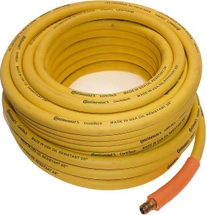
If you are evaluating options now, see Rich Tool Systems’ 3/8" rubber hose lineup for compressor hookups and workstation drops. You can compare sizes and ratings on the air compressor air hose page.
Why retractable reels improve reliability and safety
Retractable hose reels protect the hose, speed setup, and keep walkways clear. Key advantages include:
- Controlled rewind that prevents whiplash and tangles.
- Reduced abrasion, since hose travel stays straight and off the floor.
- Faster changeovers between tools and stations, which adds up over a shift.
When paired with a 3/8 inch rubber hose, reels can maintain consistent flow while minimizing kinks. See the current selection of retractable air hose reels at Rich Tool Systems to match bay length and mounting style.
Mounting best practices for clean hose travel
Proper mounting is as important as the reel itself. Follow these placement rules for smooth extension and rewind:
- Anchor to a solid structure at shoulder height to reduce strain and make latching easy.
- Align the reel so hose pays out straight toward the primary work area. If the hose must turn, use a roller guide rated for your reel.
- Keep the first 6 to 10 feet clear of sharp edges, hot surfaces, and corners that can scuff the jacket.
- Confirm enough clearance for the full swing arc on ceiling or swivel mounts.
A good test is to fully extend and retract the hose twice before putting the bay into service. Look for points of rub, hose twist, or recoil snap. Address those now, not after a busy day when fatigue and traffic increase risk.
Fittings and compatibility notes
Shop systems often mix National Pipe Thread (NPT) bodies and quick-connect couplers. Before installation:
- Verify hose end fittings match the reel and drop lines, commonly 1/4 inch or 3/8 inch NPT.
- Standardize on one quick-connect profile across bays to avoid mismatches.
- Use thread sealant compatible with air systems. Do not over-tighten brass components.
Rich Tool Systems’ 3/8" rubber hoses are available with common fitting sizes for compressors and air tools. Pairing a consistent hose ID with standardized couplers simplifies maintenance and keeps pressure losses predictable. For a complete air tool lineup to benchmark CFM needs, explore air tools at Rich Tool Systems.
Installation and leak test checklist
Use this short sequence when adding or refreshing a bay.
- Plan: Confirm tool CFM and PSI needs, reel length, 3/8 inch hose ID, and fitting sizes.
- Mount: Secure reel to a solid surface at comfortable reach. Align with primary work area.
- Connect: Install whip to the manifold or drop. Apply thread sealant per product guidance.
- Inspect: Check hose jacket and ends for shipping scuffs or kinks before charging.
- Pressurize: Bring the system up slowly. Listen for leaks at fittings and swivel joints.
- Test: Run your highest-demand tool at working pressure for 60 to 90 seconds. Watch for pressure sag and verify smooth rewind.
Seasonal maintenance to prevent airflow problems
Summer heat and daily cycles can harden seals and accelerate hose wear. Schedule quick checks to keep uptime high.
- Drain moisture from compressor tanks and filters daily. Warm air carries more water, which can corrode lines and damage tools.
- Inspect hoses weekly for soft spots, hardening, cuts, or blistering near fittings and heat sources.
- Check reel springs and latching action. Clean debris from guides so the hose pays out smoothly.
- Lubricate air tools per manufacturer guidance to manage heat and reduce internal wear.
- Store backup hoses and abrasives in cool, shaded, dry areas to prevent premature aging.
If work includes grinding or cutting near air lines, consider adding guards and using appropriate PPE. Rich Tool Systems also supplies gloves for work that balance dexterity and protection, helpful when handling hot fittings or tools.
Safety advantages you can measure
Retractable reels reduce trip hazards by keeping hose paths predictable and off the floor. Controlled rewind cuts snap-back risk. Standardizing on 3/8 inch rubber hoses that resist weather, oil, and solvents helps prevent cracks that can fail under pressure. Together, these choices add up to fewer disruptions and more consistent tool output across shifts.
Quick FAQ
- What are examples of cutting tools? Common shop examples include band saw blades, hacksaw blades, cutoff wheels, hole saws, and rotary burrs. In air-powered categories, cutoff tools and air saws also apply.
- What are the main cutting tools? In metalworking and fabrication, the core set includes saw blades, cutoff wheels, drill bits, and taps and dies for thread creation and repair.
- What is an industrial supply? It refers to tools, equipment, and consumables used by professionals in manufacturing, construction, automotive, and maintenance. These items support production, repair, and safety on the job.
Next steps
If you are preparing for peak summer activity, standardize bays now. Choose a 3/8 inch hose length that matches your layout, mount retractable reels for straight hose travel, and run the leak and flow test before the rush. To compare reel options, visit the retractable air hose reels page. To confirm hose sizes and ratings for your compressor, review the 3/8" rubber air hose selection on the air compressor air hose page. For air-driven tool requirements that inform your CFM planning, browse the full air tools category at Rich Tool Systems.
With a well-sized 3/8 inch rubber hose, a properly mounted retractable reel, and a short seasonal maintenance routine, your air system can run reliably and safely through the busiest months.